Understanding
The language learning market is one of the most crowded spaces in EdTech. Before designing anything, the question worth asking was an uncomfortable one: does the world need another app? This case study documents how that question was answered, how the research did validate a direction, and actively shaped the product thinking behind Poetly.
Believe it or not, not everyone reads poetry regularly
Interviews pointed to a consistent pattern. Serious learners outgrow their first app quickly. Duolingo is the entry point, almost universally. But those who commit to a language move on or layer other tools on top. The goal is immersion: songs, films, podcasts, conversations, anything that puts the language in a living context.
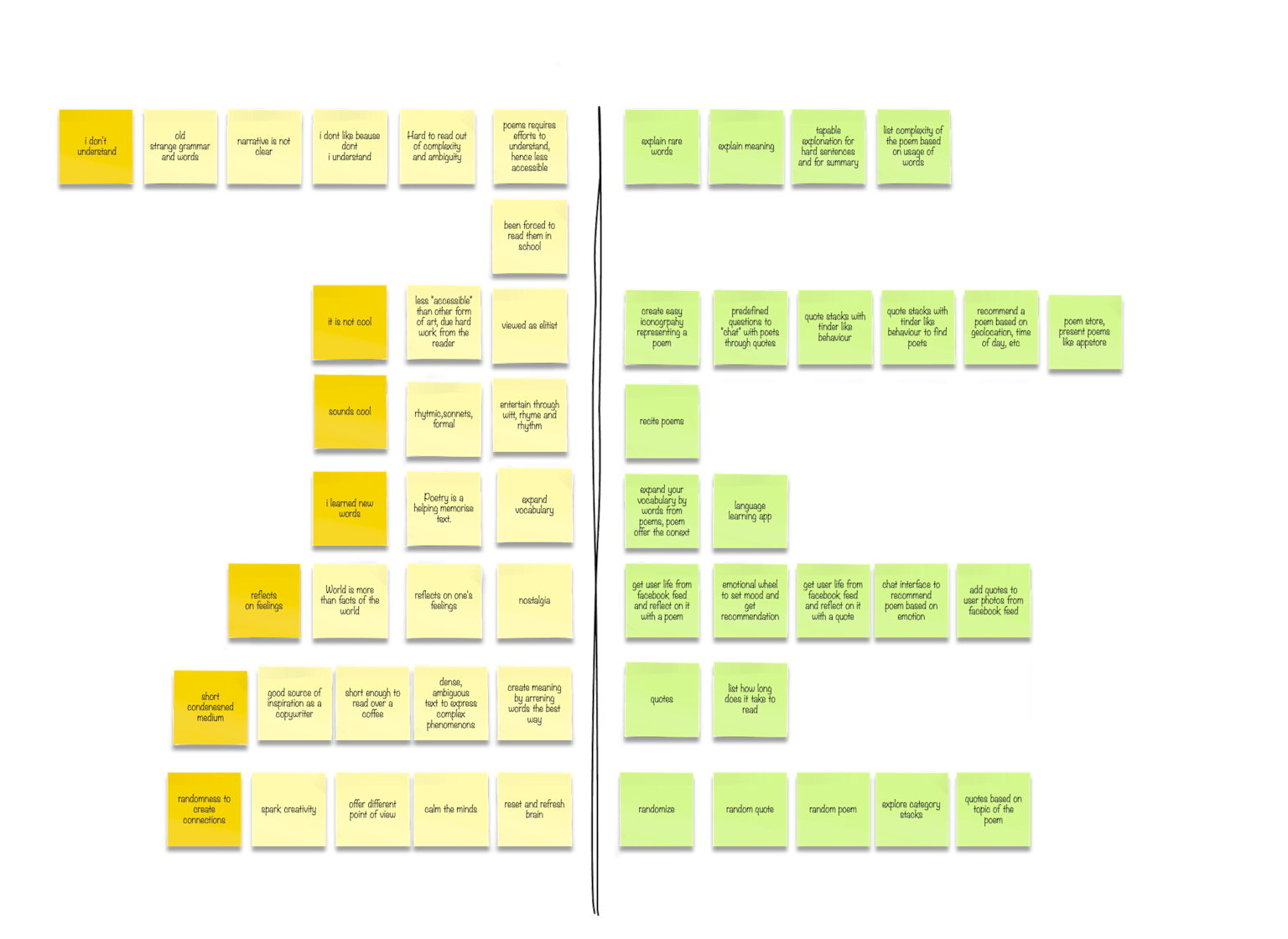
Poetry was not mentioned unprompted. But songs were, and the underlying logic is identical. Rhythm, repetition, and emotional resonance make things stick. The gap was not another beginner app. It was something for learners who already have the habit and want to go further. The affinity mapping made the pattern visible across participants — different tools, same underlying need: context over isolation.
Mapping competition
EdTech is a saturated market
The competitive landscape has a clear shape. Duolingo is the whale, the default entry point for almost every learner, built around heavy gamification and habit hooks that are hard to escape. It owns the top of the funnel.
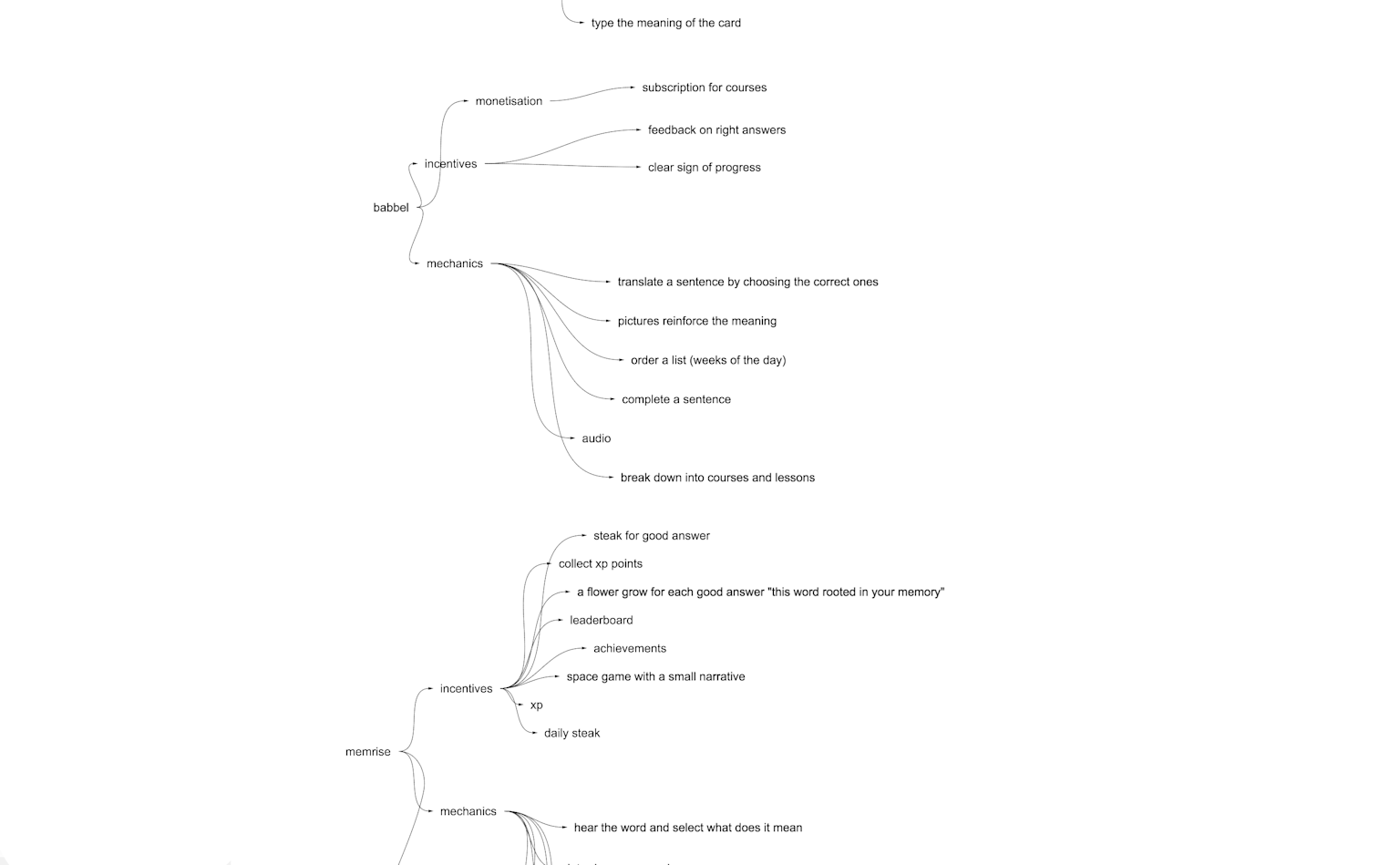
Below it, the market splits. Babbel takes the structured, classical route: progression, grammar, a more traditional learning flow. Then there are the niche players. Memrise sits closest to Poetly's territory, focused on vocabulary expansion rather than foundational fluency.
The business models converge even when the products diverge. Everyone is chasing the same subscription revenue. The opportunity is not to out-Duolingo Duolingo. It is to serve the learner who has already passed through that door and wants something with more depth, more texture, and less pressure to keep a streak alive.
- Doulingo: Offers free access with advertisements, and a subscription to remove ads and unlock extra features. The go-to entry point for most learners, built around heavy gamification and habit loops.
- Babbel: Subscription-based access to structured courses, sold per language. A more classical, grammar-forward learning flow aimed at learners who want progression over play.
- Memrise: Subscription model that includes personalised learning, additional techniques such as audio tools, and content from native speakers. The closest competitor to Poetly's niche — focused on vocabulary expansion rather than foundational fluency.
Establishing new habits
Habit formation research added a layer of realism. Duolingo's model works because it lowers the barrier to starting and punishes stopping. But that model also creates a ceiling. Once the streak becomes the goal, the language learning becomes secondary.
The reference points that shaped Poetly's approach were different: Drops, Busuu, tools that prioritise quality of engagement over frequency of opens. The hypothesis was that a learner who genuinely enjoys a session will come back without a notification.
- Course based: Busuu, Babbel, Doulingo
- Flash cards: Tiny Cards, Memrise, Upmind
- Test based: Johnny Grammar, Vocabulary.com
Defining the product
Thou art summoned to speak like Edgar Allen Poe!
This was the positioning direction that the research helped clarify. Going in, there was already a preconception: not a utility, not a habit tracker, but a voice. The research made that instinct slightly more informed, and gave it a direction worth designing toward. The idea that learning vocabulary through poetry could give a learner not just words but a register: a way of speaking that carries the weight of the poets behind it.
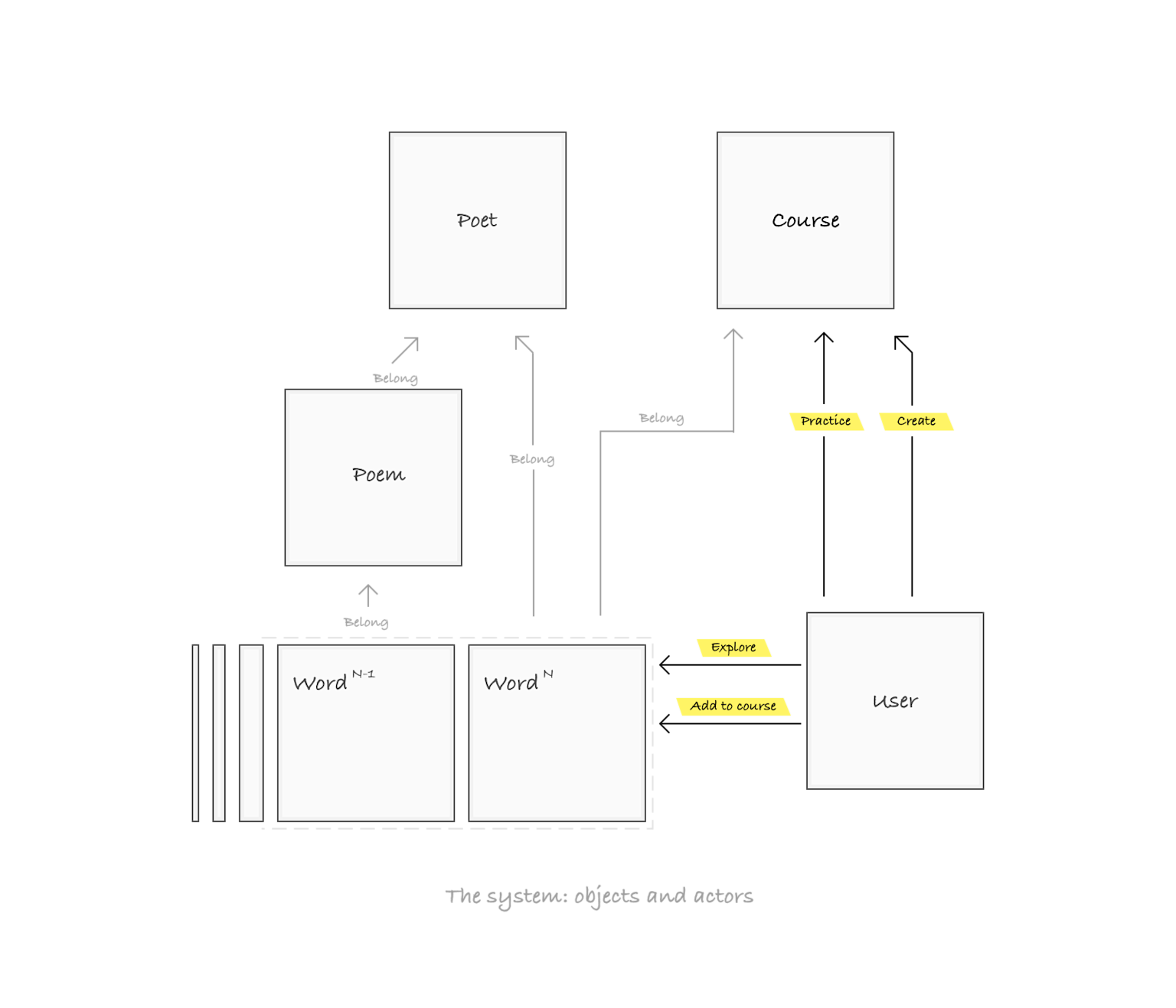
The development process began by mapping out the most important user flows, using words themselves as the building blocks. From there, the concept moved into wireframes: translating features into screens, refining hierarchy, adjusting the placement of text, buttons, and navigation.
How hard should learning feel?
Every exercise in Poetly is a small answer to the same question: how much effort is worth asking for, and what does the learner get in return? Too easy and nothing sticks. Too demanding and they close the app.
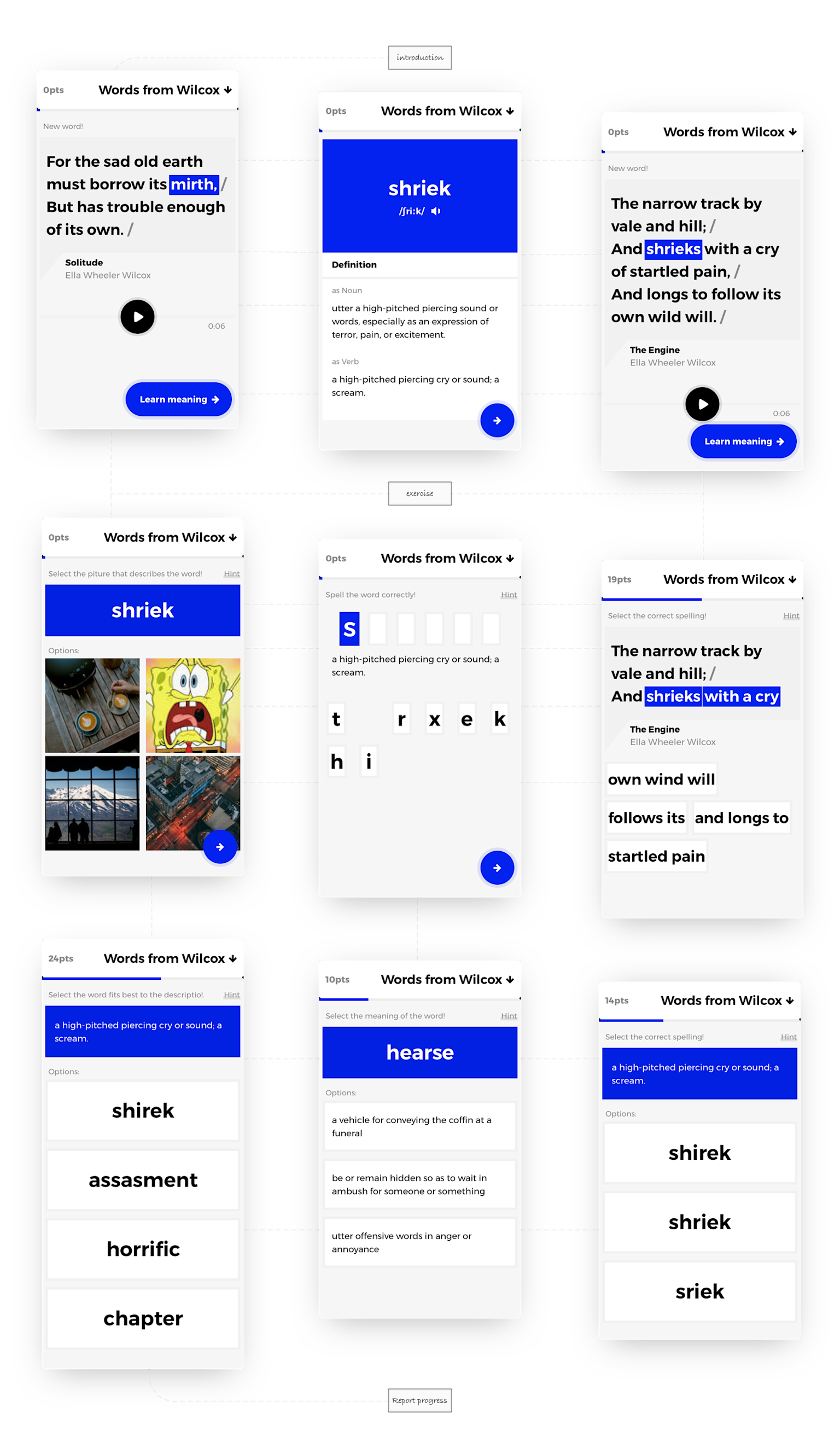
The exercise set draws on proven techniques: word recognition, spaced repetition, matching pairs, completing poetic lines, arranging verses in order. Eight exercise types in total, varied enough to sustain attention across a session. The poetic context is not decoration. It is the thing that makes the effort feel worthwhile. You are not drilling a flashcard, you are finishing a line by Whitman.
The learning exercises were the most critical part to test: they sit at the heart of habit formation, and without them being engaging, nothing else matters. A detailed prototype was designed with a strong focus on the learning mechanics behind practising a course.
Testing followed a clear scenario: participants were given context and asked to complete a practice session. Afterward, they shared their opinions and feedback on the experience. Insights from this process guided refinements: removing confusing elements, simplifying unnecessary interactions, and correcting misleading flows to create a smoother, more intuitive learning journey.
Conclusion
One source is better than none, but not enough
Participant feedback confirmed that the concept was distinctive and appealing enough to motivate downloading the app. The poetic framing landed. People said the idea was cool. Whether they would open the app on day eight, build a real vocabulary, and feel the product had delivered on its promise, that remains an open question. Attitudinal research tells you what people think in a session. It does not tell you what they do over time. In practice, one research method is a starting point. You need independent sources to verify a direction before committing to it.