How might we reimagine cybersecurity?
Creating a security solution for content creators was not just an idea; it was a business case with real potential. Together with researchers and project managers, the team validated the concept from three angles: viability, feasibility, and desirability. With these foundations in place, the concept was shaped into a focused MVP.
From idea to opportunity
70M Total Addressable Market in the U.S. by 2030
One of the first steps in turning an idea into a business is evaluating its viability. The total market capitalisation for this space is estimated at $190M worldwide, with $27M in the US alone, growing year over year. Particularly interesting was the lack of competition; nobody had built this for content creators specifically.
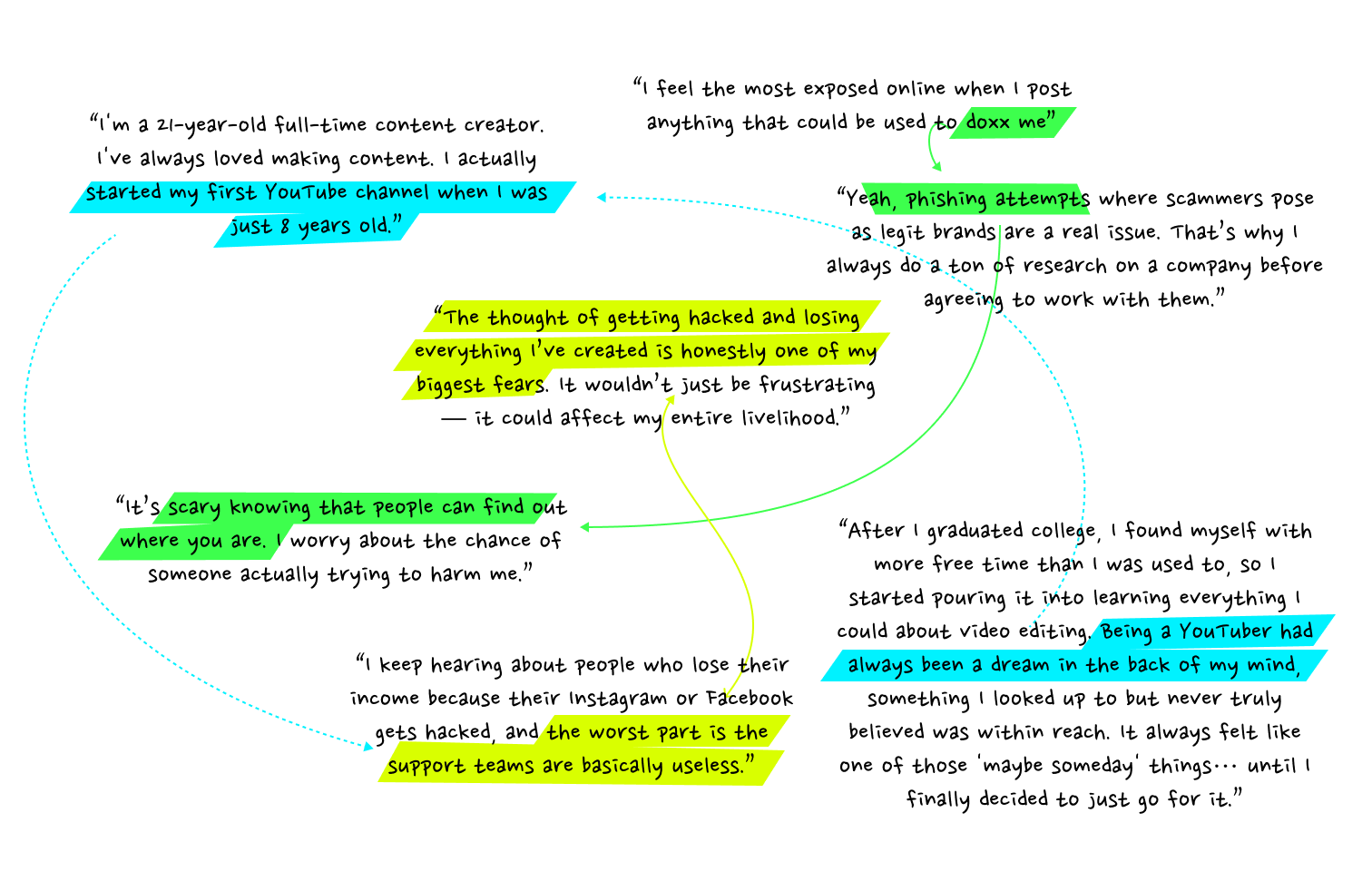
User interviews quickly confirmed that cybersecurity is not an abstract concern for creators; it is a daily source of stress. High-profile cases of social engineering, targeted attacks, and account takeovers are common and widely known in the community. Together with the R&D team, the research helped uncover patterns and weak points, shaping a set of tools designed to detect suspicious messages, prevent scams, and monitor social media accounts in the background.
The design sprint
From ideas to sketches, from sketches to prototypes
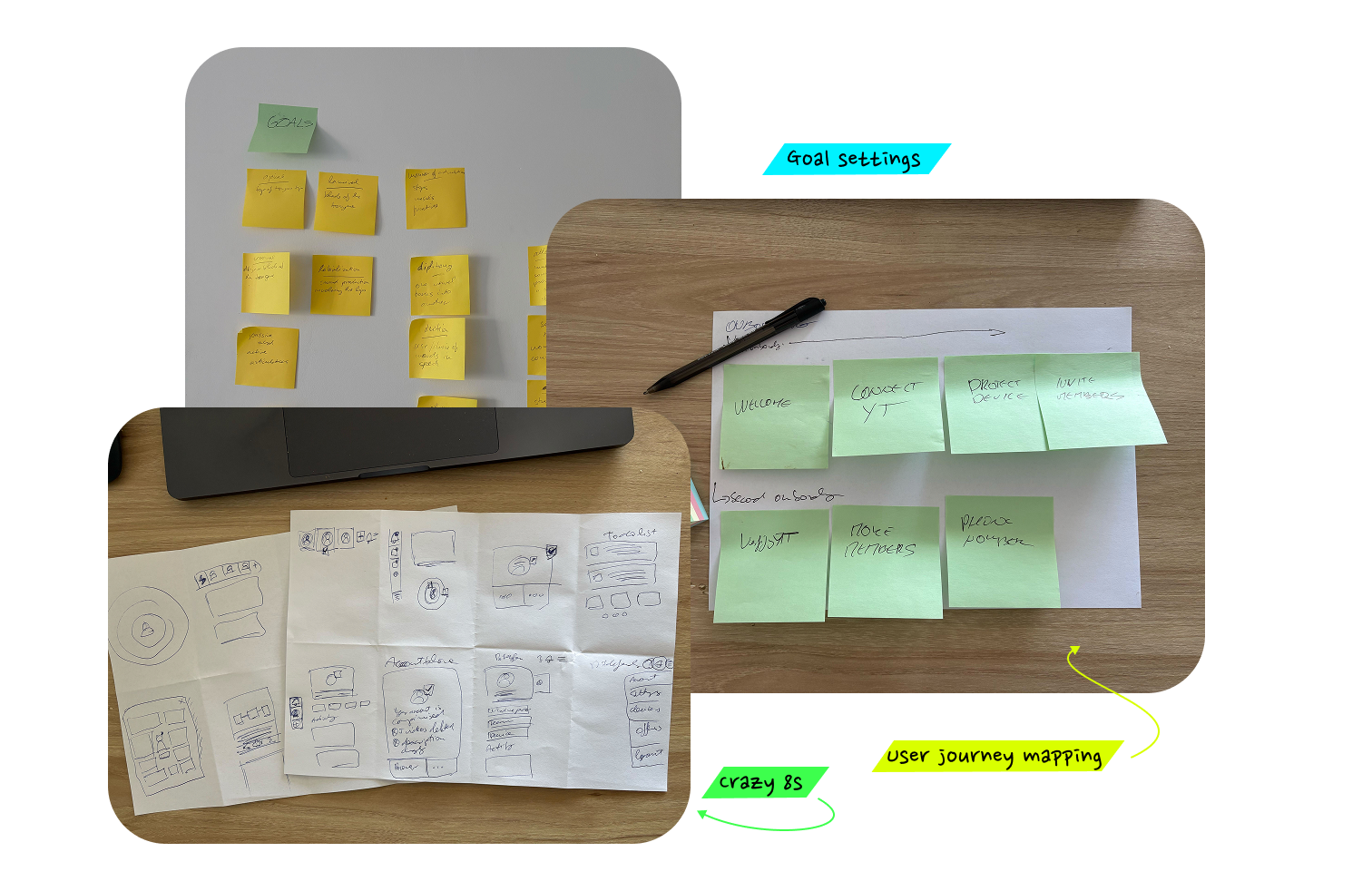
With an MVP it is all about focus. There were countless ideas and features worth exploring, but moving fast meant making deliberate choices about what mattered most. The design sprint framework gave the team structure: user journey mapping, affinity mapping, competitive analysis, crazy eights for low-fidelity ideation, and rapid sketching to move from concept to testable prototype quickly.
YouTube was the natural starting point; not just because it is the most common threat platform for creators, but because it is where the creators we wanted to reach generate most of their income. Protecting that first made the most sense.
I pushed to tailor the product experience specifically to content creators rather than repurpose existing Bitdefender interfaces. Some foundational product elements were reused where it made sense, but the goal was always a product that felt built for this audience, not adapted from another.
The onboarding problem
Don't tell them it works. Show them.
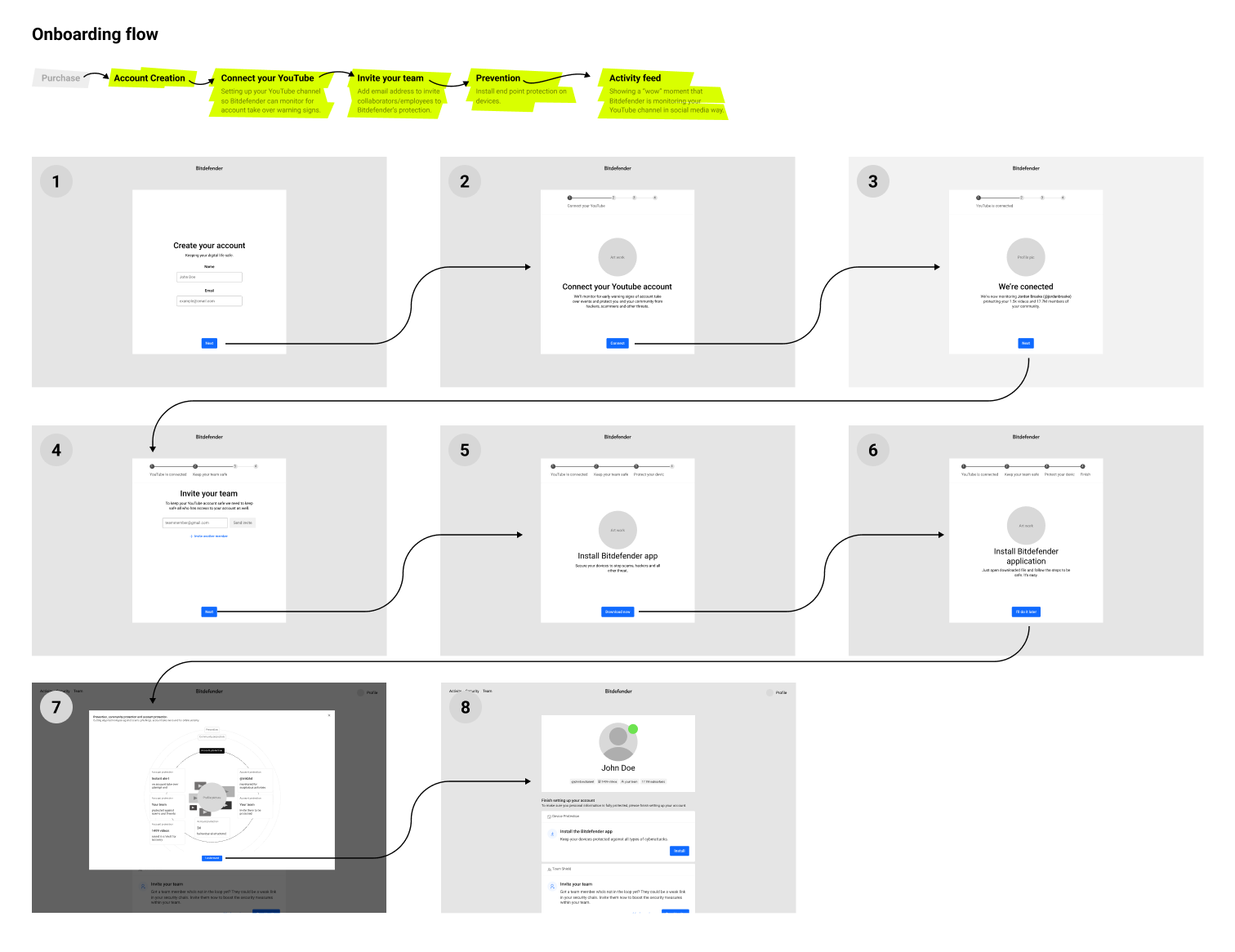
The onboarding flow was one of the most critical surfaces to get right. It needed to establish trust, communicate value, and feel native to a creator's world; all without overwhelming someone who had just signed up. Iterations focused on stripping back anything that felt like a traditional security dashboard and replacing it with something closer to the platforms creators already use every day.
A key part of this was designing a wow moment early in the flow; a screen that analysed the user's account and surfaced real information about their exposure. Not a generic welcome screen, but immediate proof that the product was already working. Seeing actual data about their own account made the value tangible from the very first session.
Testing with purpose
What do creators actually fear?
The research was designed with a specific goal: measuring creators' existing level of security awareness, understanding the tools and practices they already use to keep their accounts safe, and surfacing their hopes and fears around cybersecurity.
The study ran over two weeks, combining structured and unstructured methods to capture both spontaneous reactions and more considered responses. Unmoderated online interviews encouraged honest, unfiltered feedback. A mockup landing page was designed and tested to validate whether the concept resonated before product decisions were locked in. Short exercises helped surface attitudes and decision-making patterns. Testing recall over two weeks gave us a clearer picture of what genuinely stuck versus what only seemed to land in the moment.
Finding the right fit
Not the usual crowd
The initial focus was on small creators, but research and business analysis revealed that creators with 100k or more followers were far more serious about protecting their work as a business. They also stood to gain the most from what the product offered. The team shifted attention to creators in fashion, cooking, travel, health, and fitness; a significant move for Bitdefender, whose history had been rooted in working with tech influencers. Entering these new spaces meant stretching, adapting, and speaking the language of communities the brand had not traditionally engaged with.

Messaging was refined through performance marketing channels, landing page tests, and pricing experiments. Affiliate relationships were built, influencers were contacted directly, events were attended, and real conversations happened with people in the space. Validation was not just a research exercise; it was an ongoing process of showing up and listening.